














An annuity is a financial product offered by an insurance company that is designed to provide regular income payments. In its simplest form, you make a lump-sum payment – or, in some cases, a series of contributions – and the insurer agrees to pay you income according to the terms of your contract.
The primary purpose of an annuity is to convert accumulated savings into a predictable income stream. Rather than managing withdrawals yourself or relying entirely on the performance of your investments, an annuity provides scheduled payments that can help cover everyday expenses throughout retirement.
Many Canadians use annuities as one component of a broader retirement income strategy alongside RRSPs, RRIFs, workplace pensions, CPP, and OAS benefits. Depending on the type of annuity you choose, payments may begin immediately or at a future date, continue for a specified number of years or for the rest of your life, and include features designed to protect your spouse or beneficiaries.
An annuity converts a portion of your retirement savings into regular income payments. When you get annuities quotes and purchase an annuity from an insurance company, you enter into a contract that specifies when payments begin, how often you’ll receive them, and how long they’ll continue.
The amount of income your annuity provides depends on multiple factors and, as a result, two people purchasing similar annuities may receive different payment amounts based on their individual circumstances.
Most annuities are purchased with a lump-sum payment using either registered or non-registered savings. Before issuing the contract, the insurer calculates your expected payments based on factors such as:
These factors determine both the amount of each payment and how long those payments are expected to continue.
Once the annuity begins, you’ll receive payments according to the schedule set out in your contract – most commonly monthly, although quarterly, semi-annual, and annual payment options are also available.
Depending on the type of annuity you purchase, payments may continue for a fixed period or for the rest of your life. This can help reduce longevity risk, or the possibility of outliving your retirement savings, while providing a predictable source of income that complements other retirement assets such as CPP, OAS, workplace pensions, RRIFs, or personal investments.
While all annuities are designed to provide income, they are not all structured in the same way. Some begin making payments shortly after purchase, while others allow you to delay income until a future date. Some provide income for as long as you live, while others are designed to provide payments for a specific period of time.
The right type of annuity depends on your retirement timeline, income needs, financial goals, and the level of flexibility and certainty you are looking for.
An immediate annuity begins making payments shortly after you purchase it. This type of annuity is commonly used by people who are already retired or are approaching retirement and want to convert a portion of their savings into a predictable income stream.
Immediate annuities can be useful for retirees who want to reduce the responsibility of managing withdrawals and create a more predictable retirement budget.
A deferred annuity is designed for people who want to create future retirement income but do not need payments right away. Instead of receiving income immediately, the purchaser selects a future date when payments will begin.
Deferred annuities can be part of a long-term retirement income strategy, helping individuals plan for future expenses and create another source of predictable income later in life.
A life annuity provides income for the lifetime of the annuitant – the person whose life determines how long payments continue. This makes life annuities one of the main options Canadians consider when they want protection against longevity risk, or the possibility of outliving their savings.
Life annuities can generally be structured as:
A term certain annuity provides income payments for a specific period of time rather than for the entire lifetime of the annuitant.
Because payments are guaranteed for a defined period, term certain annuities can also include options that provide protection for beneficiaries if the annuitant passes away before the end of the guarantee period.
| Annuity Type | When payments begin | How long payments continue | Annuity Type |
| Immediate annuity | Shortly after purchase | Fixed period or lifetime, depending on the contract | Creating income during retirement |
| Deferred annuity | At a future date selected by the purchaser | Fixed period or lifetime, depending on the contract | Planning for future retirement income |
| Life annuity | Immediately or in the future | For the lifetime of the annuitant | Protecting against outliving savings |
| Term certain annuity | Immediately or in the future | Specific number of years | Covering income needs during a defined period |
When researching annuities, you may come across the terms qualified and non-qualified annuities. These terms are commonly used in the United States to describe whether an annuity is purchased with pre-tax or after-tax funds.
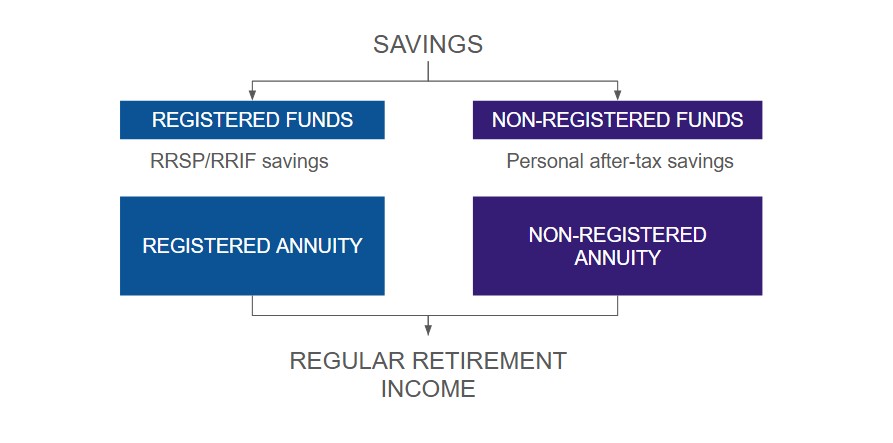
In Canada, annuities are more commonly classified as registered or non-registered annuities. The difference depends on the source of the funds used to purchase the annuity and how the income payments are taxed.
A registered annuity is purchased using funds from a registered retirement account, such as an RRSP or RRIF. Because these accounts have specific tax rules, the income received from a registered annuity is generally treated as taxable income.
Registered annuities can be an option for Canadians who want to convert retirement savings accumulated in registered accounts into a predictable stream of income.
Someone approaching retirement may use funds from an RRSP to purchase an annuity that provides regular payments after retirement, helping create a more stable income plan.
A non-registered annuity is purchased using after-tax money that does not come from a registered retirement account. The taxation of payments can differ from registered annuities because only certain portions of the income may be considered taxable, depending on how the annuity is structured.
For instance, an individual who has personal savings outside of their RRSP or RRIF may use those funds to purchase a non-registered annuity as another source of retirement income.
Choosing between a registered and non-registered annuity depends on your overall retirement strategy, existing savings, income needs, and tax situation. Because the tax treatment can vary, it’s important to consider how an annuity fits alongside other retirement income sources.
When getting annuities quotes in Canada, you may notice that different insurers can offer different payment amounts for similar products. This is because annuity rates are influenced by a range of financial and personal factors rather than a single fixed number.
Some of the main factors that affect annuity rates in Canada include:
Because so many factors are involved, two people purchasing an annuity with the same amount of money may receive different payment amounts depending on their age, selected options, and personal circumstances.
If you’ve researched annuities before, you’ve probably come across financial formulas that explain how annuity payments are calculated. These equations illustrate the relationship between the amount invested, interest rates, payment periods, and the resulting income payments.
One of the most commonly used formulas for an ordinary annuity is:
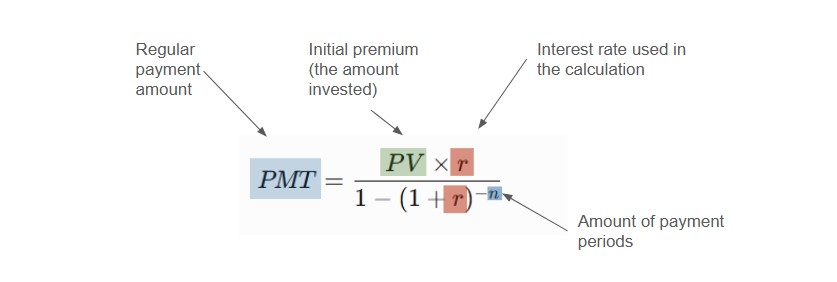
While formulas like this explain the mathematical principles behind annuities, they represent only part of the picture. When determining actual annuity payments, insurance companies also rely on actuarial models that take into account factors such as:
In other words, the financial equation provides the foundation, while actuarial calculations adapt that foundation to each individual’s circumstances and the specific annuity being purchased. That’s why two people investing the same amount may receive different payment amounts, even if they purchase similar annuity products.
When learning about annuities, you may encounter the terms ordinary annuity and annuity due. These concepts describe when payments are made during each payment period – not the type of annuity you purchase.
The key difference is simple:
| Feature | Ordinary Annuity | Annuity Due |
| Payment timing | End of each payment period | Beginning of each payment period |
| Example | Monthly payment received at the end of the month | Monthly payment received at the beginning of the month |
| Common applications |
|
|
Although this distinction is common in financial mathematics, it’s usually less important when choosing an annuity for retirement. In practice, the payment schedule is specified in your annuity contract, allowing you to know exactly when your income payments will begin and how frequently you’ll receive them.
Whether payments are made at the beginning or end of a payment period, the more important considerations are the type of annuity you choose, the amount invested, and how the annuity fits into your overall retirement income strategy.
Like any financial product, annuities offer both advantages and potential drawbacks. Whether they’re the right choice depends on your retirement goals, other sources of income, and your preference for certainty versus flexibility. Understanding both sides can help you decide whether an annuity deserves a place in your retirement income strategy.
| Advantages | Potential Drawbacks |
| Guaranteed income. Depending on the type of annuity you choose, payments may continue for a fixed period or for life, helping create a predictable source of retirement income. | Less liquidity. Once funds have been used to purchase an annuity, they generally can’t be accessed as freely as money held in investment or savings accounts. |
| Protection against longevity risk. Lifetime annuities can continue making payments even if you live longer than expected, reducing the risk of outliving part of your retirement savings. | Limited flexibility. After an annuity has been purchased, changing payment terms or accessing the original capital may be difficult or impossible, depending on the contract. |
| Reduced exposure to market fluctuations. Because payments are determined by the annuity contract rather than day-to-day market performance, annuities can provide greater stability during retirement. | Inflation risk. Unless inflation protection is included, fixed payments may gradually lose purchasing power as the cost of living increases. |
| Simplified retirement planning. Regular, predictable payments can make it easier to budget and coordinate annuity income with CPP, OAS, workplace pensions, RRIF withdrawals, and other retirement resources. | Estate planning considerations. Depending on the annuity type and guarantee options selected, there may be less value remaining for beneficiaries compared with other retirement assets. |
Ultimately, the value of an annuity depends on what you’re trying to achieve. For retirees who prioritize predictable income and financial stability, an annuity can provide confidence and simplify long-term planning. Those who expect to need greater access to their capital or maximum flexibility may prefer to combine an annuity with other retirement income strategies rather than relying on it alone.
Whether an annuity is a good choice for retirement depends on what you want your retirement savings to accomplish. While annuities are often compared with traditional investments, they are designed to achieve a different objective.
Most investment portfolios focus on growing wealth over time and may fluctuate in value as financial markets change. Annuities, by contrast, are primarily designed to provide certainty, stability, and predictable income during retirement. Rather than trying to maximize investment returns, they help convert accumulated savings into a reliable source of income that can support your day-to-day living expenses.
For this reason, many Canadians view annuities as one part of a broader retirement income strategy rather than a replacement for other financial assets. A well-balanced retirement plan may include:
The right combination depends on your financial goals, expected retirement expenses, tolerance for investment risk, and other sources of income. For many retirees, the objective isn’t choosing between investments and annuities – it’s finding the right balance between growth, flexibility, and long-term financial security.
If you’re comparing annuities with registered retirement income options specifically, our guide on RRIF vs annuity in Canada explores the differences in more detail.
At LSM Insurance, we can help you understand available choices, select an approach that aligns with your financial priorities, provide annuities quotes, and assist you with purchasing an annuity.
There is no single age or situation when everyone should buy an annuity. The right time depends on your retirement goals, financial situation, and the role you want an annuity to play in your overall income strategy.
An annuity may be worth considering if you:
Many retirees choose annuities as one component of a broader retirement plan, combining them with other income sources and investments to create a balance between certainty and flexibility.
For a deeper look at timing considerations, read our guide on when to buy annuity.
LSM Insurance can help you compare annuity options, understand how different features affect your income, and find a strategy that fits your retirement plans.
An annuity is a financial product offered by an insurance company that converts savings into regular income payments. In exchange for a lump-sum payment or, in some cases, a series of contributions, the insurer provides income according to the terms of the contract. Canadians often use annuities as part of a broader retirement strategy to create predictable income alongside other sources such as CPP, OAS, RRIFs, pensions, and investments.
Many annuities provide guaranteed income payments according to the terms of the contract. Depending on the type of annuity selected, payments may continue for a fixed period or for the lifetime of the annuitant. However, the specific guarantees, payment periods, and beneficiary protections depend on the annuity contract and options chosen.
The taxation of annuity income depends on how the annuity was purchased. Payments from registered annuities funded through accounts such as RRSPs or RRIFs are generally treated as taxable income. Non-registered annuities purchased with after-tax funds may have different tax treatment depending on how the contract is structured.
Annuities are designed primarily to provide income security rather than maximize investment returns. While certain annuities provide guaranteed payments, they generally involve giving up access to a lump sum in exchange for future income. Whether an annuity is beneficial depends on factors such as your retirement goals, financial needs, and the features included in your contract.
What happens after the annuitant’s death depends on the type of annuity and the options selected at purchase. Some annuities stop when the annuitant dies, while others may include guarantee periods, joint-life provisions, or beneficiary benefits that allow payments or remaining value to continue under certain conditions.
Neither type of annuity is universally better – the right choice depends on your retirement timeline and income needs. Immediate annuities are designed for people who want income soon after purchase, while deferred annuities are intended for those planning for future retirement income. The best option depends on when you need income and how an annuity fits into your overall retirement strategy.