













No medical life insurance is a type of life insurance that does not require medical tests. That is why it is sometimes called “No Exam Life Insurance” – it requires no in-person exams or fluid samples (like blood or urine). Some no medical life insurance types go even further and do not even require a medical questionnaire.
This is an ideal type of insurance for those who would not be approved for traditional (also called standard) life insurance that comes with medical tests and a questionnaire to complete.
The drawbacks of no medical insurance are lower insurance coverage and more expensive premiums when compared with the premiums for the same coverage of a traditional life insurance policy.
No medical life insurance works a bit differently depending on its type. Below we will look at each type.
Let’s start with simplified issue life insurance (or simply, simplified life insurance). It requires the completion of a short questionnaire. Once successfully completed, your application will be approved by an insurance company (assuming there were no reasons to decline you, as per the questionnaire) and you are covered. Here is how it would look.

Another type of no medical life insurance comes with even less work and does not require completion of any questionnaire. This is guaranteed issue life insurance (or simply, guaranteed life insurance) but the coverage does not start immediately after approval. It starts after a waiting period of two years have passed. Here is how it would look.

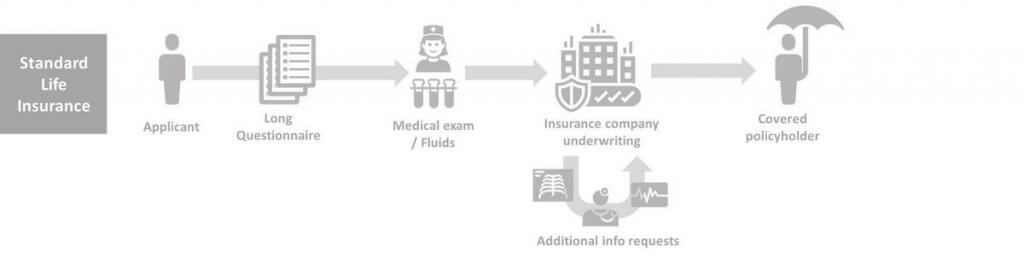
Just for comparison, we show what the same process looks like for a standard life insurance policy (e.g. term life insurance). It is more complex, includes completing a long questionnaire (multiple pages), requires a medical exam and has an extensive underwriting process during which an insurance company can request additional documents from you or your doctor.
Lorne Marr from LSM Insurance shares his experience:
“No Medical Life Insurance is exactly that – it’s life insurance that’s available without a medical (exam). Now, because it does not have a medical, there still are, generally, still some health questions. We have a guaranteed issue type policy where there are no health questions but that’s really limited to people with very severe health issues and then there is Simplified Issue which also has no medical tests but has a series of health questions and a key point with a No Medical Life Insurance with Simplified Issue policy is that you wanna find a plan that’s best for you and you wanna find a plan that offers you the best overall coverage.
So, if you someone who can qualify for a plan and answer “No” to 15 or 20 questions, that’s gonna provide you with a lot better plan than if you can only answer “No” to 5 or 6 questions. So, that’s where a broker can really come in. They can find the best No Medical Life Insurance policy for your specific needs and that’s gonna result in you getting a lot more coverage at a lot lower premium.
As a side note, a lot of the carriers have really upped the issue limits on No Medical Life Insurance policies, so now you can get a lot more coverage than you were able to years gone by.”
There several cases when you might consider no medical life insurance or, also called, no exam life insurance:
No medical life insurance comes in a few forms:
A simplified issue no medical life insurance policy (or simplified life insurance) does not require a medical exam, but still requires answering a medical questionnaire.
A guaranteed issue no medical life insurance policy (or guaranteed life insurance) does not require a medical exam or a medical questionnaire.
These policies offer various levels of coverage and have a waiting period before you can make a claim.
| Standard (Traditional) Life Insurance | Simplified Issue Life Insurance (No Medical) | Guaranteed Issue Life Insurance (No Medical) | |
|---|---|---|---|
| Rates | Low | Medium | High |
| Coverage amount (Maximum) | Up to $5,000,000 | Up to $300,000 | Up to $25,000 |
| Medical Exam | Yes | No | No |
| Medical Questionnaire | Yes | Yes | No |
| Waiting period (no claim is paid during this period) | None | Either none or 1-2 years (depending on a policy) | 2 years |
Simplified life insurance, a type of no-medical life insurance, comes with a health questionnaire, though the number of questions varies by company, typically ranging from 5 to 15. Generally, the more questions you can answer with “no,” the better your rate will be.
Here are examples of these questions:
Since questions differ across insurers, working with a broker who knows the specific questionnaires can save you significant time and money. Remember, if you’re declined for a policy, this may need to be disclosed on future applications, so a well-guided choice from the start is essential.
As with any type of insurance, no medical life insurance comes with some pros and cons. Let’s take a closer look.
| Advantages/Pros | Disadvantages/Cons |
| ⦁ Does not require a medical exam. No fluids or lab work is required and there are no medical appointments needed. ⦁ Does not have a very long questionnaire, unlike what is seen on a standard life insurance policy. ⦁ One type of no medical life insurance, guaranteed issue life insurance, does not have any questionnaire at all – everybody qualifies. ⦁ Ideal for people who have serious health pre-conditions and cannot qualify for standard medically underwritten life insurance. | ⦁ Comes at a higher price than standard life insurance for the same amount of coverage. ⦁ Coverage amounts are limited. For example, ~$300,000 for simplified issue policies and ~$25,000 for guaranteed Issue policies. ⦁ Guaranteed life insurance come with a two year waiting period (a claim will not be paid if a policyholder were to pass away from illness during this time, but premiums are returned to the beneficiary). |
Yes, no medical life insurance (or no exam life insurance) is a product that has been developed specifically for those who have serious health concerns or pre-existing conditions. It is important to know, however, that even if you have some health pre-conditions, in many cases you will be able to qualify for an underwritten rated policy. This means, you still need to do an exam and the traditional questionnaire. The cost of the policy, if approved, will be higher than standard rates, but likely lower than no medical rates. Our experienced life insurance brokers can guide you through this decision process and provide the necessary guidance.
Seniors often face increasing health conditions and other barriers when applying for traditional life insurance. Fortunately, some life insurance providers in Canada offer no-medical life insurance options for seniors up to the age of 80, or even 85. Our insurance brokers can help you find these options, as they are thoroughly familiar with the guidelines of nearly all life insurers in Canada. Find out more here about Life Insurance for Seniors.
There are a few mistakes related to no medical life insurance, as summarized below:
| Mistake | Details | |
| 1 | Going immediately for no medical life insurance without exploring all the options of standard insurance. | In many cases, rated medically underwritten life insurance might be a better choice even if you have a medical pre-condition. It would come at a better cost and offer more extensive coverage than no medical insurance. |
| 2 | Applying for standard life insurance and being declined before considering no medical life insurance. | Some simplified issue life insurance questionnaires ask if you were previously declined a life insurance policy, which will not be in your favour. The solution is to talk to an experienced insurance broker about your situation before doing a full application. A broker might be able to get a pre-assessment for you and discover if you most likely will be accepted or declined for a standard life insurance policy. If this assessment suggests you will be declined, you can apply for a simplified policy without being declined for an underwritten policy. |
| 3 | Going immediately for guaranteed life insurance without looking into simplified issue life insurance. | Simplified issue life insurance is a better option than guaranteed life insurance (if you qualify) because it comes at a lower cost, has higher coverage and has just a short questionnaire to complete. |
| 4 | Thinking that all no medical life insurance policies are the same. | Some no medical life insurance policies are a better fit for people with particular health concerns and pre-conditions since the questionnaire may not ask questions related to that particular pre-condition. It is crucial to work with a broker who is well versed across a broad range of no medical life insurance policies. |
No medical life insurance in Canada comes in two forms: simplified or guaranteed.
Nothing can disqualify you from getting guaranteed life insurance. However, it comes at a high cost and the life insured must not pass from an illness (can pass from an accident) within the first two policy years. If the policy holder does pass away from illness during the waiting period, the premiums are returned to the family.
Some very serious health pre-conditions can disqualify you from getting simplified life insurance. Although there is no medical exam, simplified insurance policies come with a short questionnaire with a few health questions. Most people can qualify for simplified, except in some cases of serious or prolonged illness. Our experienced life insurance brokers are very knowledgeable with all types of no medical life insurance and are happy to help you find the best policy for your situation. Our brokers can preview application forms to select the one that will most likely be successful for your needs and your budget.
The correct answer is, it depends. This insurance is worth it when you need a life insurance coverage but cannot qualify for standard life insurance for a variety of reasons (health pre-condition, dangerous job, fear of medical exams, etc.). In this case, no medical life insurance, especially, simplified issue insurance offers a good alternative.
The Waiting period in life insurance is the time during which an insurance policy will not pay out a claim to the beneficiaries but will return the premiums that were paid. The purpose of the waiting period is to discourage people who are terminally ill from getting a life insurance policy that will be cashed out soon after being purchased.
No, because no medial life insurance policies come in different forms, especially as related to simplified life insurance policies. Some companies will have shorter questionnaires whereas others will have longer ones with a different set of questions. Depending on your situation, some providers’ no medical life insurance products might be suited better for you than others. There might also be a significant difference in pricing. This is why we recommend working with an insurance broker who is knowledgeable in no medical life insurance products across multiple providers. Our brokers work with more insurance partners than most other insurance broker firms in Canada.
Guaranteed acceptance life insurance is another name for a guaranteed life insurance or, as insurance companies call it, guaranteed issue life insurance. This insurance comes without any medical tests/exams and has no questionnaire, so everybody can qualify. However, it comes at higher cost than any other policy and has a two year waiting period.